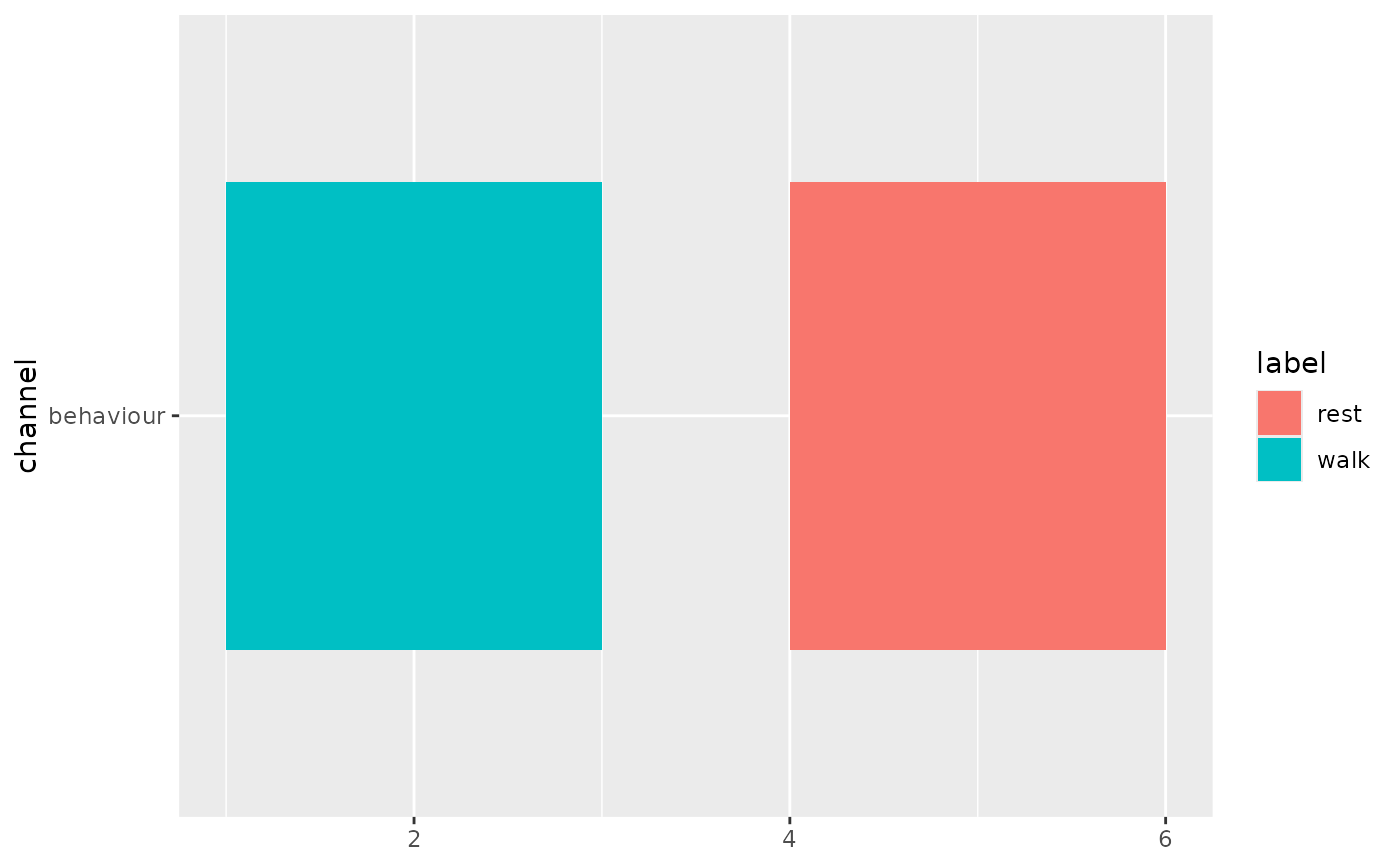
A ggplot2 layer that renders state (durative) events as rectangles
spanning each event's start -> stop on the x axis, with one row
per label on the y axis. When the input has a type column (e.g.
an anicore::anievent()), rows with type != "state" are dropped.
Usage
geom_event_state(
  mapping = NULL,
  data = NULL,
  ...,
  height = 0.7,
  na.rm = FALSE,
  show.legend = NA,
  inherit.aes = TRUE
)
Arguments
- mapping
Aesthetic mapping. Merged on top of the defaults, so you only need to supply the aesthetics you want to override.
- data
A data frame (typically an
anievent). IfNULL, inherits from the parentggplot()call. Either way, rows withtype != "state"are dropped from this layer.- height
Vertical extent of each bout bar, in y-axis units (1 = the spacing between adjacent label rows). Default 0.7.
- na.rm, show.legend, inherit.aes, ...
Passed to
ggplot2::layer().
Details
The default mapping is only aes(xmin = start, xmax = stop) — every
other aesthetic is up to the caller. Common patterns:
aes(fill = label)— colour each bout's interior by behaviour.aes(colour = label)— outline each bout (keeps sub-pixel-wide bouts visible at any zoom).aes(y = label)(ory = channel,y = subject, ...) — spread bouts across rows. With noymapping all bouts collapse onto a single line.+ ggplot2::facet_wrap(~ channel, scales = "free_y", ncol = 1)— split channels into their own panels.
Opinionated wrappers (themes, colour scales, sensible defaults) are intended to live one layer up; this geom is deliberately bare.
This is a thin wrapper around ggplot2::GeomRect: a subclass adds a
setup_data step that derives ymin / ymax from y + height, so
a discrete y scale keeps the label rows ranked correctly (including
under per-panel scales = "free_y").
Examples
library(ggplot2)
af <- anicore::example_aniframe(n_obs = 6, n_individuals = 1, n_keypoints = 1)
af$behaviour <- rep(c("walk", "rest"), each = 3)
ev <- anicore::to_anievent(anicore::set_variables_event(af, state = "behaviour"))
ggplot(ev, aes(xmin = start, xmax = stop, y = channel, fill = label)) +
  geom_event_state()